
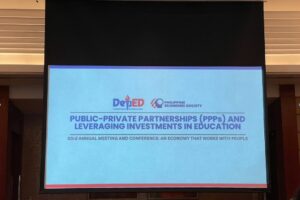
The Ministry of Education (removed) on Friday that it intends to produce 105,000 classrooms and digital spaces through the use of private partnership (PPP) for the school infrastructure project (Psip).
“It will test the core of our governance to bring these classes and the sense of our commitment, as a nation, to do well with our students,” said under the administration of the nation Ronald U. Mendoza said at a press event in Makati.
“I’m just trying to emphasize here that we will be proving something as a nation if we can get this, and the best vehicle we can use is the PPP,” he added.
The PPP framework was adopted reluctantly in 2010 to address the backward class. “We have not changed its names, and we are trying to stick to the old model, which was already approved about 12 years ago,” said Mr. Mendoza.
The first phase of Psip was completed in 2016 and built 9,296 classrooms in regions I, III, and IV – worth P16.43 billion.
The Psip 2 phase, on the other hand, costs P3.86 billion and includes the design, financing, and three toilets, and toilets in 1,735 public schools, III, iX, Car, and Caraga.
“It was able to build 13,391 classrooms, these two incidents,” said Mr. Mendoza.
Following the same framework, the new generation of Psip aims for the construction of 105,000 classrooms from 2026 to 2031.
“This country has never produced 105,000 classrooms in such a short period of time,” said an accurate official.
The third phase of Psip aims to build 15,000 classrooms in regions I, II, III, IV-A, IV-B, V, Car, and NCR. In Psip IV, the Department aims to build 40,000 classrooms in regions VI, VII, Nir, VIII, and selected areas in Luzon.
At that time, regions ix, x, xi, xii, XIII, barmm, and other sites can be covered by the first two waves included in the first two waves included in Psip V.
“What we’ve tried to do is start with a quick batch of classrooms that can be produced,” Mr Mendoza said. “Then you go through these same parts twice to get the deficit out of these different states.”
In addition to classroom construction, Psip also aims to address the digital gap in the field through Psip Connect, which aims to distribute devices, Internet connectivity, and power to public schools across the country.
“PPP classrooms are very important, and we must build, but it is the digital connection that will change the trajectory of our students,” he said.
The latest backlog in the classroom in the country, entered 165,000, from the data of 2022, according to Mr. Mendoza. “We have built some classes in the classroom since 2022, we have lost many classes since 2022, and we have accepted new students since 2022.”
Data from the depth revealed that region 4A has the highest shortage of classes with 31,002, while the administrative region of Cordillera (car) has the lowest grass with 2,301.
Mr. Mendoza noted that 54% or 89,050 of the Classroom Deficit are in the classroom, followed by 31% or visayas with 15% or 24,948.
“To be able to reduce that deficit, in economic terms, we have to build faster than 11,000 at least,” said Mr. Mendoza.
“We have to build faster than 11,000 plus (due to) classrooms damaged by earthquakes, volcanic eruptions and typhoons,” he added. – Almira Louise S. Martinez


