Billions lost from Commo Control Scandal could go to money, education, lawyer says

The billions of pesos that could be lost in the alleged flood control could have social services, including the health and education sectors, which help to deal with the inequality of the rich country (aer).
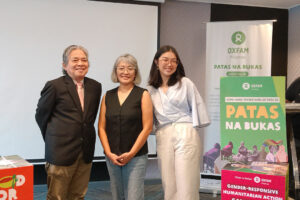
“Billions of pesos could save so many lives if they went to our public hospitals and to the benefit of FilHealth (Philippine Health Insurance),” Sofia Beatriz “Pia” Rodrigo, speaking Businessworld Alongside its report was presented in collaboration with Oxfam Pipipipinas on Tuesday.
It is possible for too many children to become malnourished and to finance their education.
The report is entitled “Inequality in a broken place: a call to embed equality in the Philippines’ Economic Agenda” to find that the Philippines ranks 15 out of 20 countries 12 in the year 2021.
It also noted that the country remained the most vulnerable in the Southeast Asian region.
The report also points to the findings of the Philippine Statistics Authority (PSA), which shows that the richest population will earn more than double, or 115% more, than the poorest 40% in 2023.
“So for every peso received by the poorest Filipinos, Cicest receives about 150 pesos,” Mai Lagman, Policy and Communications Officer of Oxfam Pilipinas, said during the event.
Among the key drivers of the country’s inequality are the lack of high-quality jobs – meaning permanent, skill-based jobs – and limited access to education and health care, Ms. Rodrigo said.
He pointed out that in terms of health, the cost of the Philippines Affort-of-Pocket (Oop) remains the highest in the province of Southeast Asia (ocean) by 45,5% from 2021.
Filipino students also lag behind, with 76% to 84% lower scores in science, reading, and math, says the Program for International Student Assessment (PISA).
To close the gap, filomeno STA. Ana III, Managing Director of Aer said that the pursuit of economic growth is not enough.
“While high growth has contributed to the reduction of poverty in East Asia, the experience of the Philippines shows that growth alone is not enough opportunities and repeated policies,” Mr. STA. Ana said.
The act of economic reform (AER) also clamps down on high sin taxes on alcohol, tobacco and drugs to help generate more revenue for the health sector.
The group said the government could also explore lowering wealth taxes on the country’s high net worth.
Ms. Rodrigo added that the Philippines should enter new industries that use emerging technologies such as artificial intelligence (AI), instead of relying solely on manufacturing.
Also, Oxfam and Aer are demanding full accountability for those involved in the flood control project’s institutions, saying the program has robbed the nation of funding and social opportunities. – Edg Adrian A. EVA