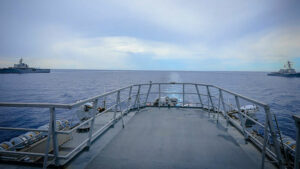
The Philippines is looking more closely at adopting anti-missile systems and drones in its armed forces, a senior Defense Department official said Monday, as China’s provocations continue to persist in the South China Sea.
Assistant Minister of Defense August V
“Drone technology enhances our ability to sense, see, design and act with greater precision and speed,” said a senior official of the Department of Defense on technology in a keynote address at a conference of the Philippine Navy.
Remotely produced drones have become the backbone of modern warfare due to their long reach due to the low cost compared to other advanced weapons, such as anti-flying missiles, and have seen heavy use in Ukraine since Ukraine in 2022.
“The rapid evolution of drone systems, whether in the air, at sea, at sea, or under the waves, has changed the way nations prepare for and respond to threats,” Mr Gaite said.
He said the Philippines needs its armed forces to cover many areas in order to support its sovereignty, with a security contribution to address critical security gaps.
Philippine forces trained in Weaman Weapon Systems, including US-Marine Expeditionary Ship anti-submarine warfare system
Unmanned systems are among the “most promising” areas for the domestic defense industry to thrive, Mr Gaite said, noting that local engineers are already growing prototypes for military use.
“Reliable development and unplanned integration are no longer optional; they are essential,” he said. “The challenge now is to scale these innovations to bridge the gap between prototype and production in concept and performance.”
And on Monday, the Armed Forces of the Philippines (AFP) implemented an order to strengthen coordination with allied nations, including joint exercises and defense.
Army Chief General Romeo S. Brawner, Jr. We say that the strategic command is “a big step” in strengthening the defense situation of the armed forces and “joint forces.”
“This is not just the implementation of a new command; it is the birth of a strategic vision,” said a separate statement.
The AFP said the strategic command “will serve as a strategic plan where intelligence, operations and civilian military operations converge to provide faster decisions and improved coordination.”
“It will oversee and coordinate joint exercises and engagements with allies and partners,” it added.
Competing claims between the Philippines and China in the South China Sea have led to constant fighting involving the repeated use of territorial waters and attacks by Chinese ships against Philippine ships.
The waterway has become a regional flashpoint as Beijing asserts sovereignty over the entire waterway, defying a 2016 ruling by the Permanent Court of Arbitration on its outstanding claims.
Security cooperation and alliances have been boosted under President Ferdinand R. Marcos, Jr., who has taken a stand against Beijing’s maritime claims compared to his successor.
The Philippines has relied on multilateral cooperation to build its maritime capabilities and promote cooperation with its allies in contentious waters. – Kenneth Christiane L. Basilio