Win or lose at the Supreme Court, Trump has other tax tools at his disposal


The decision of the Supreme Court of the World is driven by President Donald Trump’s use of powers related to the international economy, or ieeesta, to force extensive tax rates that would remove the cudgels that he likes to punish his political countries.
The court, with a conservative majority of 6-3 including the three Jules appointed by Trump in his first building, took up the challenge on Wednesday, which was established by small business groups and several areas. It is not clear how quickly the high court can issue an opinion.
Trump is the first president to invoke this provision – which is often used to impose economic sanctions on opponents – to withhold payment.
Uncertainty surrounds the future of trade talks between Canada and the US as the Trump Administration’s trade plan heads to the Supreme Court and Treasury Secretary Donald Trump’s latest threats may not come true.
The law gives the President the power to deal with “extraordinary and routine threats” to national security, foreign policy or the economy. Often, it has been used to impose sanctions on enemies or freeze assets, including the September 11, 2001, attacks on the United States.
In this case, Trump envisioned a $1.2-trillion US trade deficit by 2024 as a national climate emergency – even though the United States has continued to trade every year since 1975.
Trump has complained, at times in harsh and violent language, of other countries taking advantage of the US in trade. The case before the court was so important to him that he met by attending the oral arguments (but chose not to).
A number of laws allow fees to be paid
US Treasury Secretary Scott Besstent said he expects the Supreme Court to increase tax rates based on Ieepa. But when the high court strikes down the tax rates, says the firebrand, the administration simply shifts to other tax authorities.
Those include section 122 of the Trade Act of 1974, which allows 15 broad tariff rates in 150 days to calm trade imbalances.

Bessent said Trump could also invoke section 338 of the Tariff Act of 1930, a provision that allows tax rates of up to 50 percent in developing countries.
Trump is already using other authorities on certain taxes.
He is very busy under tariffs under section 232 of the Trade Expansion Act of 1962 which includes national security that protects strategic security, including autos, copper, robots, robots and aircraft.
Also, section 301 of the Trade Act of 1974 allows for the use of tariffs as part of trade difficulties.
“You have to think they’re here to stay,” Syessent said of Trump’s taxes.
For countries that have negotiated lower tariffs with Trump, “you have to honor your deal,” Bessent said. “Those of you who get a good deal should stick with it.”
Great doctrines can emerge
Opponents of Trump’s tax bill argue that the US Congress, not the President, has the authority to impose taxes and levies, and that any grant of that authority should be clear and limited.
EArlier this year, two lower courts and seven of the 11 judges on the US Court of Appeals for the federal circuit basically. The state circuit, in its unsigned opinion, wrote that it is “clarified” that the language of the statute regarding the Trial “includes the power to impose a fee on the administration thereof.”

The Criminal Court of the United States of the Federal ruled that most of the US President Donald Trump’s amounts are illegal – but it was allowed to remain in the US Supreme Court. In a social media post, Trump called the court “for the most part” and said all taxpayers are still working.
But James Taranto, a federal judge appointed by President Barack Obama, wrote the dissent, joining three other judges.
“We do not see Ieeesta as eyes but an eye-opening choice to submit to the President the broad authority to choose the tools to prevent the importation” in the country of national emergency, wrote Taranto.
They argued that the legal principle called the great doctrinal questions should be the tax rates of Sodom. The doctrine requires executive branch actions of “substantial economic and political importance” to be expressly authorized by Congress.
The Supreme Court raised serious questions about the doctrine that has been repeated in cases during the administration of Joe Biden to stop some of his agenda items, including his plan to cancel $430 billion in student debt. The court found clear approval of DRM was lacking in those cases.
Addicted to tax rates?
In April, Trump imposed tariffs on imports from some countries to deal with shortages.
These follow-up tariffs were announced in February as an Economic Benefit to China, Canada and Mexico to curb the trafficking of painkillers that are used for self-abuse and illegal drugs in the United States and illegal drugs in the United States.
The Trump administration has released its tariffs as a way to pressure major trading partners such as Japan and the European Union to negotiate major agreements that will help reduce US trade, and opposition to those agreements will survive any Supreme Court decision.
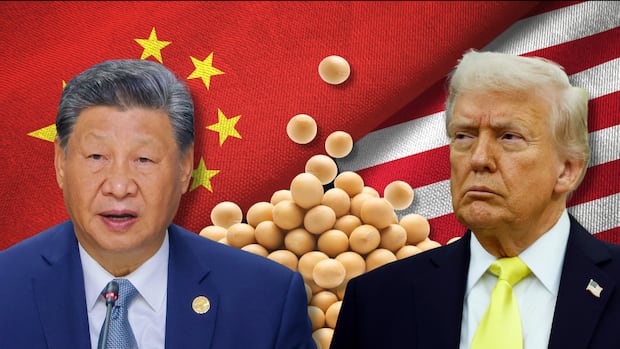
China consumes and imports more soybeans than any other country in the world – and the United States is its main supplier. But what happens in the US when its biggest customer suddenly stops buying? Andrew Chang breaks down how China is using its currency as a mace, why we President Donald Trump rushed to talk to him and what is the other push for soybeans. Photos provided by The Canadian Press, Reuters and Getty Images
Since April, the administration has announced deals, or frameworks related to the agreement, with several countries.
Instead of a big concession, the Trump administration had to settle for extensions of the critical period in which the American and Chinese tariffs were reduced so that the world refused to flow.
The parameters of trade relations with Washington’s North American partners are currently to be resolved. Trump has also scrapped an update to the North American Free Trade Agreement that he saw and signed during his presidency.
Some investors said financial markets, which have been active in the Trump Tariff State Quo, could be thrown into turmoil if the high court strikes down Ieepta’s tariffs.
The main reason for concern, especially in the financial market, is the risk of the return of more than $ 100 billion in Ieepta Cariffs and take out hundreds of billions of dollars in the financial year.
Ieepta’s taxes collected so far this year are the largest increase of $118 billion in net customs receipts for the 2025 fiscal year that ends on September 30.
That helped in the security of health care, social security, interests and the military, helping to reduce the US Deficit slightly to $ 1.715 trillion.
“It’s a big political economy risk in the risk that we get addicted to the tax bill,” said Ernie Tedeschi, a senior fellow at the Yale University Budget Lab, adding that it makes it harder to find jobs.


